

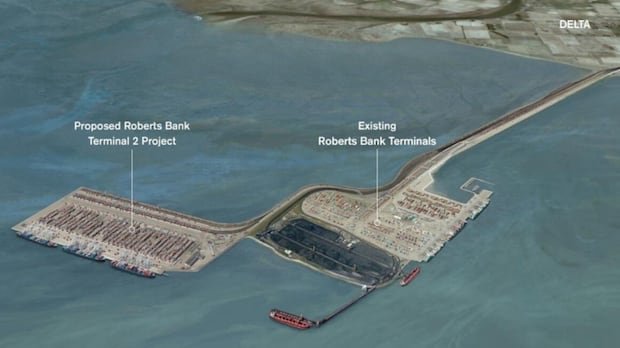

The Canadian government is moving forward with the process to potentially classify the Roberts Bank Terminal 2 port expansion in Metro Vancouver as a project of national importance. A notice appearing in the Canada Gazette on August 29 initiates a 30-day consultation period to assess whether to categorize the port expansion as a national interest project under the Building Canada Act. This law enables projects identified as being in the national interest to undergo an accelerated approval process, including environmental evaluations.
The Liberal government, in its announcement regarding the potential classification of both the terminal and the Mackenzie Valley Highway project in the Northwest Territories, emphasized that these projects could enhance Canada’s transportation and trade networks, ultimately bolstering the country’s long-term economic sovereignty. Despite these claims, environmental organizations express concerns that expediting the port expansion process might lead to circumventing environmental safeguards.
The Roberts Bank Terminal 2 (RBT2) port expansion initiative, spearheaded by the Vancouver Fraser Port Authority, aims to establish a three-berth container terminal that would amplify the port’s capacity by nearly 50% and facilitate approximately $100 billion in annual trade capacity. The federal government sanctioned the project in 2023, imposing 370 obligatory conditions to address environmental apprehensions. Concurrently, in the same year, British Columbia granted the project an environmental assessment certificate accompanied by an additional 16 conditions.
Both levels of government recognized that the project would likely generate significant adverse environmental impacts but deemed these effects justified under the circumstances. The RBT2 project is presently in the process of attaining final environmental authorizations, including clearance from Fisheries and Oceans Canada concerning compliance with the Species at Risk Act (SARA). However, if the project attains national-interest status, the Cabinet could potentially acquire discretionary authority to grant exemptions from SARA.
In July, Prime Minister Mark Carney unveiled $10 billion in federal backing for the expansion project as part of a broader agreement with British Columbia. The proposed expansion is slated for construction in the Fraser River estuary, an area considered crucial for the survival of numerous species, many of which are endangered.
“This is an incredibly vital breeding ground ecosystem for over a hundred endangered species,” remarked Julia Levin, the associate director of national climate at Environmental Defence, a Canadian environmental advocacy group. She highlighted the potential impact of establishing a mega port in this biodiverse estuary, which would involve the destruction of nearly 200 hectares of habitat.
In a legal battle last year, a Federal Court judge dismissed a lawsuit filed by multiple environmental groups who contended that the project would devastate critical chinook salmon habitat and jeopardize the survival of southern resident killer whales. Southern resident killer whales, part of over 600 wildlife species listed under SARA, are dwindling in numbers, with only 75 remaining individuals.
Chinook salmon, crucial for the southern resident killer whales’ diet, face habitat loss, with approximately 85% of their habitat disappearing due to development and infrastructure. To address environmental reservations, the port authority outlined plans to restore 102 hectares of habitat in collaboration with First Nations to support key species such as juvenile Chinook salmon and Dungeness crab.
Moreover, the port authority aims to enhance protections for southern resident killer whales by mandating ships to participate in programs that reduce underwater noise. The British Columbia Environmental Assessment office emphasized that during construction, officers would oversee the project for adherence to provincial requirements throughout its lifespan.
The federal government also proposed allocating $258 million over five years to safeguard whales and their habitats, with a specific focus on protecting southern resident killer whales. Despite these efforts, environmental advocates caution that expediting these projects may prioritize construction at the expense of the southern resident killer whales and environmental safeguards.