

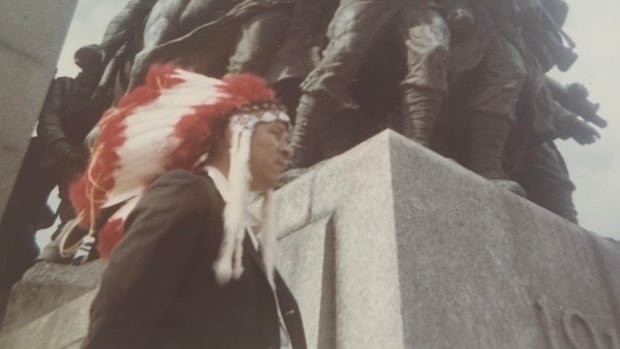

A street in a French community has been dedicated to Second World War veteran Peter J. Barlow, a former chief of the Mi’kmaw community of L’nui Menikuk (Indian Island) in eastern New Brunswick. The town of Saint-Aubin-sur-Mer in Normandy recently unveiled Chief Peter Barlow Lane to honor his service with the North Shore (New Brunswick) Regiment, one of the initial Canadian units to land on Juno Beach on D-Day.
Loretta Perley, daughter of Peter Barlow, expressed that her father, who passed away in 2000, would have been delighted by this recognition. She described him as a laid-back, amiable, and intelligent individual. Perley recounted her father’s memories of the harrowing D-Day landing in France on June 6, 1944, where he witnessed a sea of blood and had to brave gunfire to reach the shore.
During his time in France, Barlow assisted a farming family with various agricultural tasks, which was greatly appreciated. Years later, descendants of the family he helped personally thanked him when a group of tourists from France visited.
Joannie Fraser, associated with the Juno Beach Centre in Normandy, highlighted the special connection between the North Shore (New Brunswick) Regiment members and the French locals due to the presence of francophones within the regiment, enabling effective communication.
In a message shared at the unveiling ceremony, the honorary colonel of the regiment, Paolo Fongemie, expressed gratitude for the symbolic gesture of naming a place after Peter John Barlow. Fongemie praised Barlow’s dedication to his community and his remarkable journey from a young soldier to a respected Mi’kmaw leader.
Barlow, born in 1920, assumed the role of chief at a young age and continued serving the community for decades even after the position became an elected one. Post-war, he engaged in various occupations and played a significant role in advocating for Indigenous rights and establishing essential programs for the community’s welfare.
Despite Indigenous contributions to the war effort, they faced discrimination upon returning to Canada, being denied benefits and recognition granted to other veterans. Loretta Perley emphasized the long struggle for equal rights and recognition, expressing regret that her father did not witness the acknowledgment of his wartime efforts during his lifetime.
Perley recalled the challenges Indigenous veterans faced, including the denial of voting rights until 1960. She reflected on her father’s character, describing him as a compassionate individual who aided others whenever possible.