

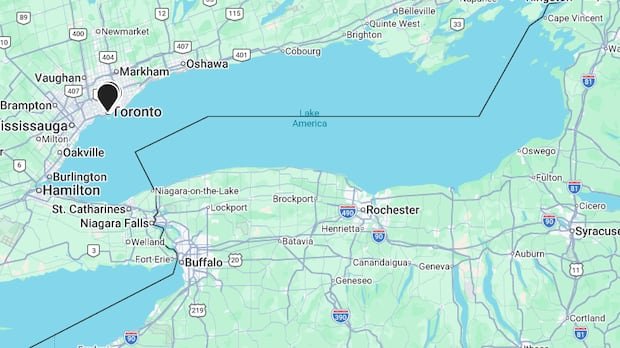

On Sunday, several Canadian websites, including those of the federal government, exhibited maps depicting Lake Ontario as Lake America. This alteration followed an announcement by Google Maps to conform to a directive from U.S. President Donald Trump. Google stated in a post on Saturday that the modification was in response to the U.S. government’s official renaming of the lake in its geographical names database.
While Google mentioned that the change would impact U.S. users only, numerous Ontario and Canadian websites seemed to reflect Lake America on their maps. Among these sites were Hydro One’s outage map, the Liquor Control Board of Ontario (LCBO) store locator, GO Transit’s station finder, and the federal government’s housing and infrastructure map. Hydro One acknowledged the error, attributing it to a third-party mapping service and confirming efforts to rectify the geographic mislabeling promptly.
Metrolinx, the Ontario government agency overseeing GO Transit, also acknowledged the issue and affirmed plans to ensure accurate identification of Lake Ontario on their websites. By late Sunday afternoon, the problematic GO Transit map had been disabled, and the LCBO map had been corrected to display Lake Ontario again.
Contrary to Google’s adjustment, MapQuest, another online mapping service based in the U.S., declared its intent to retain the name Lake Ontario. Meanwhile, Apple has not publicly addressed the matter. Google clarified that developers embedding Google Maps on their sites can localize the map by selecting a specific region, thereby determining the displayed place names.
Tech expert Carmi Levy explained that Canadian websites, such as those of Hydro One and the LCBO, likely utilize Google’s application programming interface (API) to power their maps, leading to the default switch to Lake America. Levy highlighted that APIs lack location awareness, resulting in the unintended labeling discrepancies observed.
Levy emphasized the importance of website developers selecting Canada as the region on the backend to localize their maps properly. Despite Google’s recommended solution, Levy anticipates ongoing variations in results until a comprehensive resolution is achieved due to varying levels of technical expertise among developers.