

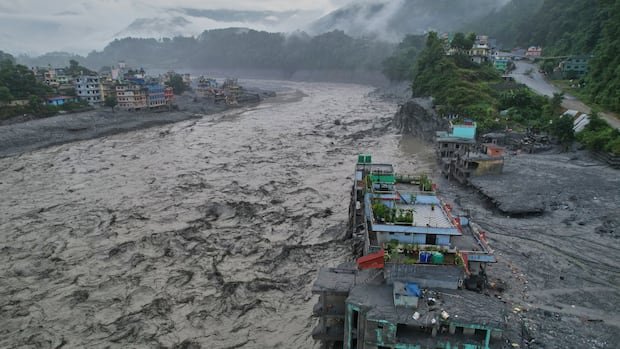

Authorities in Nepal issued a warning about potential new flooding on Sunday, advising residents in flood-affected districts to stay vigilant as water levels in the Bhotekoshi River increased. Flood alerts were sent to people’s mobile devices early that morning while rescue teams cleared a critical highway linking Kathmandu to an area severely impacted by the devastating floods last Wednesday, resulting in a death toll of at least 800 individuals and over 3,000 individuals reported missing in both Nepal and Tibet.
The recent cautions followed communication from Chinese authorities to their Nepalese counterparts regarding heightened water flow upstream. According to Dharam Raj Uprety, the head of Nepal’s National Disaster Risk Reduction and Management Authority, Chinese state news agency Xinhua reported that a newly formed lake from the previous floods in the mountainous region had mostly drained. However, the potential risk persisted from a crater situated 5.6 kilometers upstream holding an estimated 1.4 million cubic meters of water, necessitating close monitoring.
As of Sunday, Nepal’s disaster agency confirmed a death toll of 788 and 2,502 individuals missing, while Chinese authorities reported 16 casualties and 546 missing persons on their side of the border. Among the missing were numerous individuals from various countries who were in the area for work, tourism, or religious purposes. In Tibet, Chinese state media indicated that 261 foreigners, including over 100 Nepalis and others from different nations, were unaccounted for.
Rescue efforts continued at multiple hydroelectric projects, including a significant operation at the Upper Trishuli complex, where approximately 350 individuals were believed to be trapped inside a tunnel. Over 10,000 Nepali troops, in collaboration with specialists from China and India, were deployed for tunnel rescue operations, as stated by Uprety.
In one of the worst-affected regions, Dhading, residents began returning to their devastated homes to assess salvageable items. Meanwhile, at a severely damaged power plant serving over 20,000 people across four districts, workers initiated inspections to evaluate the extent of destruction. The aftermath of the floods left homes, vehicles, and farm equipment buried under sediment, and electricity remained unavailable in several areas due to damaged power infrastructure.
The tragic flash floods were triggered by a glacial collapse in the Himalayan region, causing massive devastation downstream in Tibet and Nepal. Nepal’s foreign affairs minister emphasized the urgent need for a global response to climate change, highlighting the disproportionate impact on Nepal despite its minimal contribution to global emissions. While scientists refrained from directly linking the disaster to global warming, they warned that rising Earth temperatures, largely driven by human activities, could heighten the frequency of such calamities, particularly in rapidly warming regions like the Himalayas.