

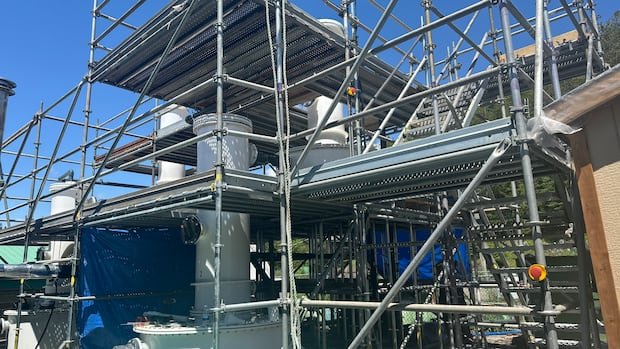

A startup in Nova Scotia is conducting trials on a technique to capture and retain more carbon within the ocean, utilizing a new test facility to validate the idea. The ocean already acts as a significant repository for surplus carbon dioxide, having absorbed roughly 30% of all human-induced carbon emissions since the 1980s.
pHathom, the company behind the initiative, aims to enhance the removal of emissions from the atmosphere by capturing carbon dioxide and transforming it into a form suitable for secure storage in the ocean over extended periods. To demonstrate the safety and effectiveness of their method, they will carry out tests at the Huntsman Marine Science Centre in St. Andrews, N.B.
Kimberly Gilbert, the CEO and co-founder, emphasized the importance of proving the viability of local solutions to address the global climate challenge. The company’s process mirrors a natural phenomenon where rainwater, enriched with carbon dioxide, interacts with alkaline rocks like limestone, converting the carbon dioxide into bicarbonate, which can then be sequestered in the ocean.
By replicating this process within a controlled reactor, pHathom’s method involves exposing seawater to carbon dioxide emissions from a biomass power plant, altering the water’s acidity. The acidic water is then mixed with small limestone particles in a tank to transform the carbon dioxide into bicarbonate, which is subsequently reintroduced into the ocean with a pH level akin to regular seawater.
Various companies in Nova Scotia are exploring different iterations of carbon removal techniques under the umbrella of alkalinity enhancement. pHathom’s approach emphasizes the use of concentrated carbon dioxide for enhanced efficiency and measurable environmental impacts due to the enclosed reactor setup.
During the pilot phase, the goal is to capture 0.1 tonnes of carbon dioxide daily, with the process generating treated water for testing purposes to observe its effects on marine life over three months. The potential scalability of such carbon removal technologies faces challenges related to energy consumption and regulatory frameworks, as highlighted by experts in the field.
Despite these hurdles, the urgency of the climate crisis underscores the importance of investigating and advancing promising carbon removal technologies while transitioning away from fossil fuels. Canada’s position as a leader in ocean alkalinity enhancement research has prompted calls for international collaboration and regulatory frameworks to facilitate the adoption of such innovative solutions.