

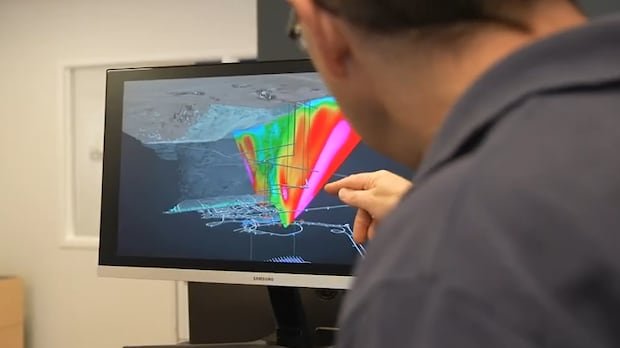

A cutting-edge technology utilizing subatomic particles to scan beneath the Earth’s surface is revolutionizing mineral exploration in the Yukon’s Macmillan Pass region. This innovative approach, funded by the federal government’s Digital Technology Cluster program, received over $21 million to develop and implement the groundbreaking technique.
The technology, spearheaded by a collaboration including Simon Fraser University, Ideon Technologies, and Fireweed Metals, utilizes sensors to detect muons, subatomic particles generated by cosmic rays colliding with the Earth’s atmosphere. These muons interact differently with various densities of materials underground, helping identify mineral deposits like zinc, lead, and silver.
Traditionally, mining companies have relied on costly and time-consuming exploratory drilling to uncover underground resources. However, this new technology offers a more efficient and environmentally friendly alternative. By generating 3D models of the subsurface, companies like Fireweed Metals can pinpoint ore locations with precision, reducing the need for extensive drilling campaigns.
The potential of this technology extends beyond mineral exploration, offering valuable insights for various industries. Despite initial skepticism, the proven effectiveness of the method has attracted partnerships with leading mining companies and garnered recognition for its innovative contributions to Canadian technology and innovation.