

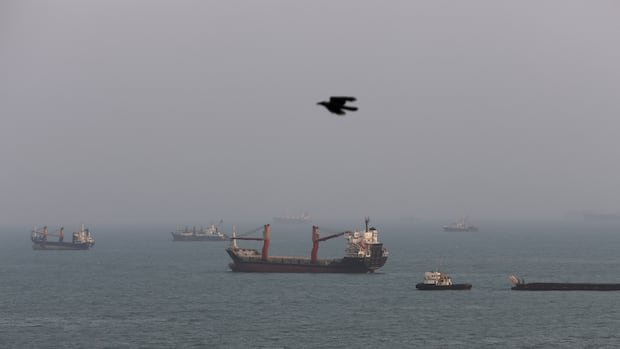

President Donald Trump stated on Tuesday that there are no planned discussions with Iran and no meetings have been arranged, while Iran’s chief negotiator emphasized that the closure of the Strait of Hormuz will persist until the U.S. fulfills the terms of an interim agreement signed in June.
The June agreement, referred to as the memorandum of understanding, required a cessation of all military activities and established a 60-day deadline for reaching a permanent resolution to end the conflict and settle the longstanding dispute regarding Iran’s nuclear program. This deadline expired on Monday.
Differing viewpoints were presented by both sides on Tuesday, with Trump asserting on Truth Social that the strait was “open and functioning,” claiming that all Iranian mines in the area had been either removed or detonated. However, commercial traffic in the Hormuz has significantly reduced compared to pre-war levels following U.S. and Israeli strikes on Iran that initiated the conflict on Feb. 28.
Trump previously shared an image depicting the Strait of Hormuz as “New U.S. Territory.” As tensions escalated, the U.S. reinstated a naval blockade initially enforced in April, restricting all maritime traffic to and from Iranian ports by mid-July.
Mohammad Bagher Qalibaf, Iran’s parliamentary Speaker and former negotiator in talks with the U.S., reiterated on Tuesday that Iran intends to maintain control over shipping in the strait until the U.S. fulfills its obligations under the agreement, including lifting the blockade, unfreezing assets, ending oil sanctions, ceasing military threats and operations, and fulfilling other commitments.
The June memorandum aimed to reopen the Strait of Hormuz, allowing Iran a role in facilitating traffic, potentially enabling the imposition of fees post-deadline. Iran has utilized this provision to assert authority over the waterway, through which a significant portion of global oil and natural gas supplies transited prior to the conflict.
Both sides accused each other of breaching the terms of the June pact within weeks, with Iran targeting vessels near Oman’s coast and the U.S. conducting strikes within Iran. In response, Tehran launched drones at Arab nations hosting U.S. forces, such as Jordan, Kuwait, and Bahrain.
The U.S. revoked waivers that permitted Iran to sell oil internationally and reimposed a blockade on Iranian ports. Trump rebuffed Iran’s demands, insisting that Tehran should pay reparations for the war and maintaining that the U.S. controls the strait, employing economic pressure through the blockade and existing sanctions to outlast Iran.
A ship was struck by a projectile as it exited the Strait of Hormuz on Tuesday, according to the U.K. Maritime Trade Operations centre. Although no entity claimed responsibility for the attack, it underscores the risks of navigating the strait amid Iran’s restrictions on shipping, even as negotiations with Oman proceed to manage this vital passage for global energy supplies.